1. **Peak 655 cm⁻¹ (Strong, Sharp):** - **Assignment:** C-H out-of-plane bending in aromatic rings. - **Functional Group:** Aromatic ring. - **Justification:** Peaks in the 650–900 cm⁻¹ range often correspond to aromatic C-H out-of-plane bending vibrations, indicating the presence of an aromatic system.
2. **Peak 828 cm⁻¹ (Strong, Sharp):** - **Assignment:** C-H out-of-plane bending in substituted aromatic rings. - **Functional Group:** Substituted aromatic ring. - **Justification:** This wavenumber is characteristic of specific substitution patterns in aromatic rings, further supporting the presence of an aromatic system.
3. **Peak 942 cm⁻¹ (Medium, Sharp):** - **Assignment:** C-H bending in alkenes or out-of-plane vibrations in substituted aromatics. - **Functional Group:** Alkene or aromatic substitution. - **Justification:** Peaks near 900–1000 cm⁻¹ often correspond to C-H bending in alkenes or aromatic systems.
4. **Peak 1042 cm⁻¹ (Medium, Broad):** - **Assignment:** C-O stretching in alcohols, ethers, or esters. - **Functional Group:** Ether or alcohol. - **Justification:** C-O stretching vibrations typically occur in the 1000–1300 cm⁻¹ range, suggesting the presence of an oxygen-containing functional group.
5. **Peak 1334 cm⁻¹ (Medium, Broad):** - **Assignment:** C-H bending in alkanes or methyl groups. - **Functional Group:** Alkane or methyl group. - **Justification:** Peaks near 1300–1400 cm⁻¹ are characteristic of C-H bending in alkanes or methyl groups.
6. **Peak 1558 cm⁻¹ (Weak, Broad):** - **Assignment:** N-H bending in amines or amides. - **Functional Group:** Amine or amide. - **Justification:** Weak, broad peaks in the 1500–1600 cm⁻¹ range often correspond to N-H bending vibrations.
**Conclusion:** The FTIR spectrum suggests the presence of an aromatic compound with oxygen-containing functional groups (e.g., ether or alcohol) and possible amine or amide groups. The sharp peaks in the 650–950 cm⁻¹ range confirm an aromatic system, while the broad peaks at 1042 cm⁻¹ and 1558 cm⁻¹ indicate the presence of C-O and N-H bonds, respectively. The compound likely belongs to the class of aromatic ethers, alcohols, or amides.
This discussion presents an infrared spectral analysis combining
automated interpretation with reference comparison to support
functional group identification and structural assessment.

FTIR Spectrum Interpretation Summary
Comparative Analysis Conclusion
AI-assisted Interpretation Conclusion
**Analysis of FTIR Spectrum:**
1. **Peak 655 cm⁻¹ (Strong, Sharp):**
- **Assignment:** C-H out-of-plane bending in aromatic rings.
- **Functional Group:** Aromatic ring.
- **Justification:** Peaks in the 650–900 cm⁻¹ range often correspond to aromatic C-H out-of-plane bending vibrations, indicating the presence of an aromatic system.
2. **Peak 828 cm⁻¹ (Strong, Sharp):**
- **Assignment:** C-H out-of-plane bending in substituted aromatic rings.
- **Functional Group:** Substituted aromatic ring.
- **Justification:** This wavenumber is characteristic of specific substitution patterns in aromatic rings, further supporting the presence of an aromatic system.
3. **Peak 942 cm⁻¹ (Medium, Sharp):**
- **Assignment:** C-H bending in alkenes or out-of-plane vibrations in substituted aromatics.
- **Functional Group:** Alkene or aromatic substitution.
- **Justification:** Peaks near 900–1000 cm⁻¹ often correspond to C-H bending in alkenes or aromatic systems.
4. **Peak 1042 cm⁻¹ (Medium, Broad):**
- **Assignment:** C-O stretching in alcohols, ethers, or esters.
- **Functional Group:** Ether or alcohol.
- **Justification:** C-O stretching vibrations typically occur in the 1000–1300 cm⁻¹ range, suggesting the presence of an oxygen-containing functional group.
5. **Peak 1334 cm⁻¹ (Medium, Broad):**
- **Assignment:** C-H bending in alkanes or methyl groups.
- **Functional Group:** Alkane or methyl group.
- **Justification:** Peaks near 1300–1400 cm⁻¹ are characteristic of C-H bending in alkanes or methyl groups.
6. **Peak 1558 cm⁻¹ (Weak, Broad):**
- **Assignment:** N-H bending in amines or amides.
- **Functional Group:** Amine or amide.
- **Justification:** Weak, broad peaks in the 1500–1600 cm⁻¹ range often correspond to N-H bending vibrations.
**Conclusion:**
The FTIR spectrum suggests the presence of an aromatic compound with oxygen-containing functional groups (e.g., ether or alcohol) and possible amine or amide groups. The sharp peaks in the 650–950 cm⁻¹ range confirm an aromatic system, while the broad peaks at 1042 cm⁻¹ and 1558 cm⁻¹ indicate the presence of C-O and N-H bonds, respectively. The compound likely belongs to the class of aromatic ethers, alcohols, or amides.
This discussion presents an infrared spectral analysis combining automated interpretation with reference comparison to support functional group identification and structural assessment.
raw image: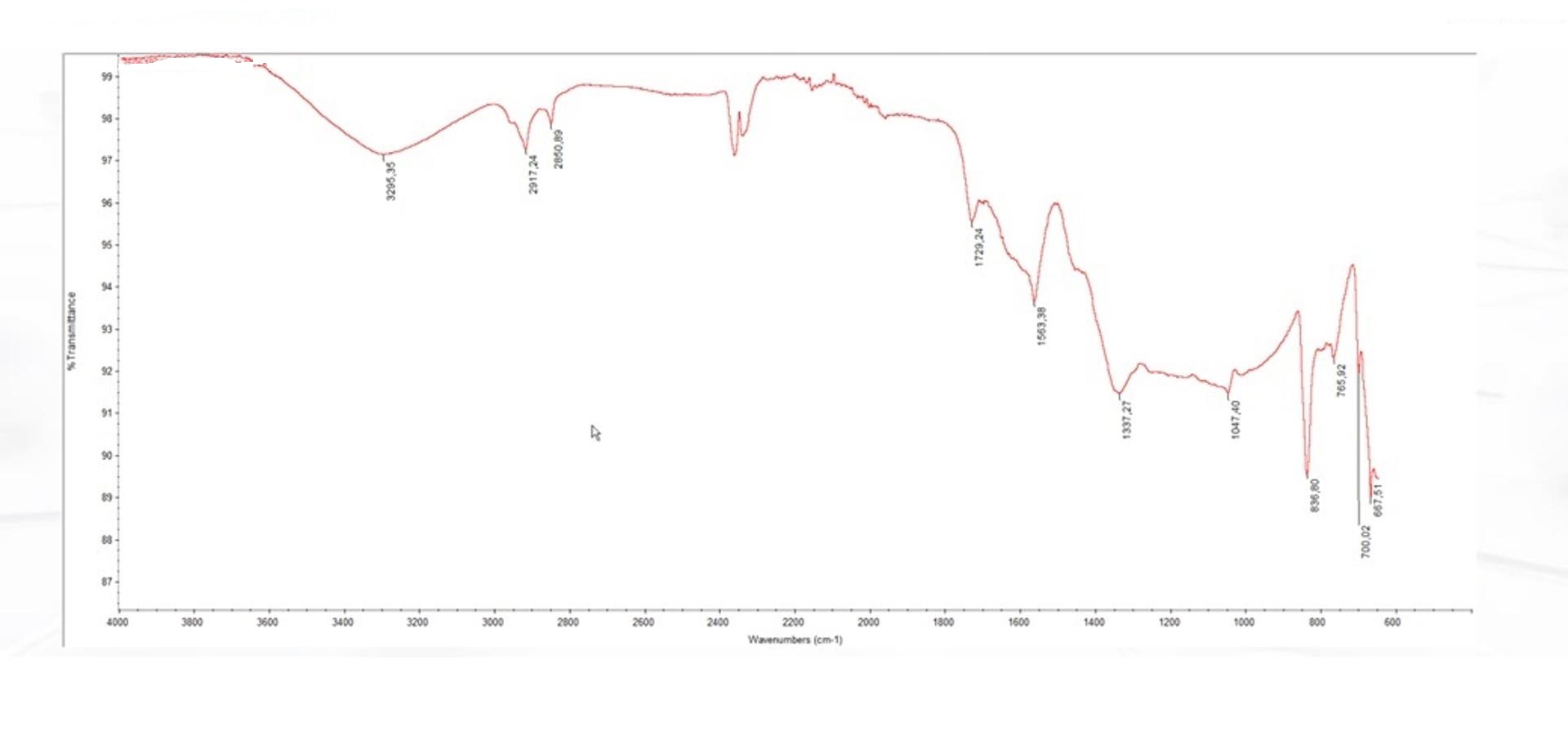 tem.csv
en&2