Pahina ng Resulta

Aromatic compound with hydroxyl and amine/amide functionalities

Tingnan ang ulat sa itaas. Gamitin ang mga komento sa ibaba kung kailangan mo ng karagdagang pag-uusap.

Resulta Blg.: 20260107063622124646938 May-ari: bedanga Mga Komento: 1
  • Translating report into Filipino. English is shown for now.
FTIR ANALYSIS REPORT

FTIR Spectrum Analysis Report

No.: 20260107063622124646938 Date: Reported by: FTIR.fun Contact: [email protected]

Download a professional, formatted PDF of this analysis.

Top15

Similarity-ranked Top-15 library comparison

Library spectrum will appear here.
Library spectrum Interactive sample curve Move the pointer to show the vertical guide line.
Top 15 candidates

Reference library candidates

Rank Match % Compound Name Formula / SMILES Library preview Action
Reference candidates load with this Top-15 workbench.

Based on the library matches and evidence above.

Conclusion

Aromatic compound with hydroxyl and amine/amide functionalities

Library direction
Pangkalahatang kumpiyansa
#18949 Current rank 1 Library lead match 93.6%
Conclusion
  1. Direct peak-to-literature correlations confirm O-H stretching at 3308 cm−1 (melanoidins) [1] and 3282 cm−1 (platelet-rich fibrin) [3], and N-hydroxyl at 3268 cm−1 (polymer-supported N-hydroxyphthalimide) [4], all compatible with a hydroxylated aromatic amine.
  2. The strong library similarity to furan-3-ylmethanol (aromatic furan with primary alcohol) further supports an aromatic alcohol core, while the top-15 candidates frequently contain methoxy and amide motifs.
  3. Reference interpretation (Arivazhagan and Rexalin, 2013) explicitly attributes the 1010 and 1017 cm−1 features to aromatic C-H bending with minor ring asymmetric deformation, reinforcing the aromatic assignment.
Main limitation

The 1017 cm−1 band has also been assigned to silicon-oxygen stretching [5]; however, this is inconsistent with the predominantly organic spectral character and the absence of silicate-related bands in the library top candidates.

Evidence & interpretation
Evidence

Key evidence

Nangungunang tugma sa library
furan-3-ylmethanol #18949 | match 93.6%
Direksyon ng materyal
Aromatic compound with hydroxyl and amine/amide functionalities The FTIR spectrum indicates an aromatic compound containing hydroxyl and amine/amide groups. Aromatic C-H in-plane bending modes at 1010 and 1017 cm−1, combined with a characteristic N-H stretching triplet in the 3268–3308 cm−1 region, point to an aromatic amine or amide structure with additional O-H contributions. The presence of methoxy or alkoxy substituents cannot be excluded but is not definitively confirmed.
Supporting peaks
1010 cm-1 1017 cm-1 3268 cm-1 3282 cm-1 3308 cm-1
Supporting groups
n_h aromatic methyl oxygen ring nitrogen ch_bending ring_asymmetric_deformation
Support

Evidence supporting the conclusion

Only sample-relevant statements that support the present conclusion are shown here.

  1. The FTIR spectrum indicates an aromatic compound containing hydroxyl and amine/amide groups. Aromatic C-H in-plane bending modes at 1010 and 1017 cm−1, combined with a characteristic N-H stretching triplet in the 3268–3308 cm−1 region, point to an aromatic amine or amide structure with additional O-H contributions. The presence of methoxy or alkoxy substituents cannot be excluded but is not definitively confirmed.
  2. Direct peak-to-literature correlations confirm O-H stretching at 3308 cm−1 (melanoidins) [1] and 3282 cm−1 (platelet-rich fibrin) [3], and N-hydroxyl at 3268 cm−1 (polymer-supported N-hydroxyphthalimide) [4], all compatible with a hydroxylated aromatic amine.
  3. The strong library similarity to furan-3-ylmethanol (aromatic furan with primary alcohol) further supports an aromatic alcohol core, while the top-15 candidates frequently contain methoxy and amide motifs.
  4. Reference interpretation (Arivazhagan and Rexalin, 2013) explicitly attributes the 1010 and 1017 cm−1 features to aromatic C-H bending with minor ring asymmetric deformation, reinforcing the aromatic assignment.
  5. The bands at 1010 and 1017 cm−1 are assigned to aromatic C-H in-plane bending and ring asymmetric deformation, consistent with an aromatic ring system (PC5, PC6).
  6. The broad absorption envelope with maxima at 3268, 3282, and 3308 cm−1 is characteristic of N-H stretching vibrations in amines/amides, corroborated by multiple literature reports of similar patterns in amide-containing materials (PC71–PC73).
  7. Additional O-H stretching contributions from hydroxyl groups are indicated by literature assignments for the same peaks [1,3,4], supporting the presence of both N-H and O-H functionality.
  8. Major peak assignments include 1017: Related literature: C-H in-plane bending / ring asymmetric deformation (aromatic); Si-O stretching (silicate/siloxane) | Direct reference: n h; oxygen; 1010: Related literature: C-H in-plane bending / ring asymmetric deformation (aromatic); Si-O stretching (silicate/siloxane) | Direct reference: n h; oxygen; 3268: Related literature: N-H stretching (amines/amides) | Direct reference: n h; oxygen; 3282: Related literature: N-H stretching (amines/amides) | Direct reference: n h; oxygen.
Limitations

Evidence that limits the conclusion

  • The 1017 cm−1 band has also been assigned to silicon-oxygen stretching [5]; however, this is inconsistent with the predominantly organic spectral character and the absence of silicate-related bands in the library top candidates.
  • The exact molecular structure remains ambiguous because the N-H signals cannot be explained by the library top-1 candidate (furan-3-ylmethanol), which lacks nitrogen.
  • It is unclear whether the sample is a mixture of an aromatic amine/amide and a hydroxyl component, or a single compound containing both functionalities.
Recommendation

Suggested next verification

  • Elemental analysis (especially for nitrogen) and NMR spectroscopy are recommended to confirm the amine/amide nature and to resolve structural details.
  • If a mixture is suspected, chromatographic separation (e.g., GC-MS or LC-MS) could help isolate and identify individual components.
Peak analysis

Detected peaks and interpretation

★ = Literature-supported peak assignment.

Index Characteristic Wavenumber Absorbance Evidence One-line interpretation Citation Confidence
1 1017 1.00 Pagtatalaga na suportado ng literatura Ang band sa 1017 cm-1 ay itinalaga sa C-H in plane bending / ring asymmetric deformation (aromatic)[S1]. [S1] Kumpiyansa ng LLM
2 1010 0.71 Pagtatalaga na suportado ng literatura Ang band sa 1010 cm-1 ay itinalaga sa C-H in plane bending / ring asymmetric deformation (aromatic)[S1]. [S1] Kumpiyansa ng LLM
3 3268 0.24 Pagtatalaga ng analogical literature Ang band sa 3268 cm-1 ay itinalaga sa N-H stretching (amines/amides)[S2][S3][S4]. [S2], [S3], [S4] Kumpiyansa ng LLM
4 3282 0.24 Pagtatalaga ng analogical literature Ang band sa 3282 cm-1 ay itinalaga sa N-H stretching (amines/amides)[S2][S3][S4]. [S2], [S3], [S4] Kumpiyansa ng LLM
5 3308 0.24 Pagtatalaga ng analogical literature Ang band sa 3308 cm-1 ay itinalaga sa N-H stretching (amines/amides)[S2][S3][S4]. [S2], [S3], [S4] Kumpiyansa ng LLM
Literature

References

263 local KG peak-level literature source(s) kept in the candidate pool; peaks 1010, 1017, 3268, 3282, 3308; groups =c_h_in_plane_deformation, acetylene, acids, alkene.

No. Title Page
[1] Patrignani 和 Gonzalez-Forte - 2021 - Characterisation of melanoidins derived from Brewe -
[2] Gregorio 等 - 2017 - Analysis of human bodily fluids on superabsorbent -
[3] Egle 等 - 2022 - Injectable Platelet-Rich Fibrin as a Drug Carrier -
[4] Culica 等 - 2019 - Recyclable Polymer-Supported N-Hydroxyphthalimide -
[5] Ashby 等 - 2013 - The effect of alkyl chain length on the level of c -
[S1] Arivazhagan 和 Rexalin - 2013 - Vibrational spectra, UV-vis spectral analysis and 5
[S2] Kert 等 - 2021 - Application of Fragrance Microcapsules onto Cotton 13
[S3] Sciutto 等 - 2017 - A Multivariate Methodological Workflow for the Ana 10
[S6] Zviagina 等 - 2020 - Distinguishing Features and Identification Criteri 8
Appendix

Sample information and raw spectrum

Original uploaded spectrum for reference and verification.

Baseline correction method: Asymmetric Least Squares Smoothing

The wavelength range for analysis(cm-1): N/A

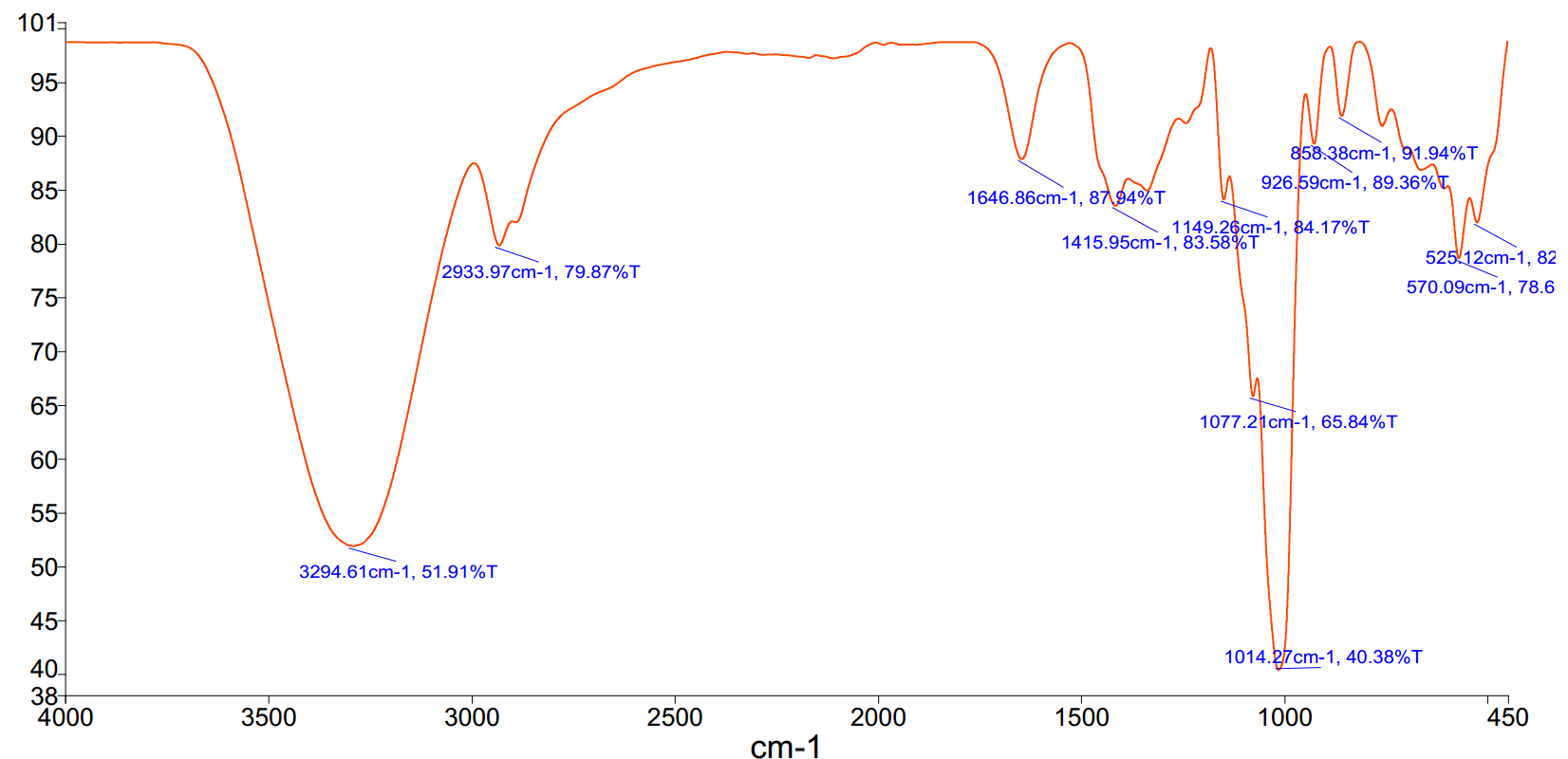
Raw spectrum without baseline correction or other processing:

Sample spectrum image
Talakayan

Mga komento at sumunod na ebidensya

Gamitin ang lugar na ito upang ipagpatuloy ang interpretasyon, magtanong, o magdagdag ng dagdag na ebidensya ng pagpapatunay.

Isumite ang Kahilingan Formularyo