
PAGE DE RÉSULTATS

aromatic ether/phenol-like material with carbonyl functionality

Consultez le rapport ci-dessus. Utilisez les commentaires ci-dessous si vous avez besoin d'une discussion de suivi.

N° de résultat: 20260102171458228754165 Propriétaire: publicuser Commentaires: 1
  • Translating report into Français. English is shown for now.
FTIR ANALYSIS REPORT

FTIR Spectrum Analysis Report

No.: 20260102171458228754165 Date: Reported by: FTIR.fun Contact: [email protected]

Download a professional, formatted PDF of this analysis.

Top15

Similarity-ranked Top-15 library comparison

Library spectrum will appear here.
Library spectrum Interactive sample curve Move the pointer to show the vertical guide line.
Top 15 candidates

Reference library candidates

Rank Match % Compound Name Formula / SMILES Library preview Action
Reference candidates load with this Top-15 workbench.

Based on the library matches and evidence above.

Conclusion

aromatic ether/phenol-like material with carbonyl functionality

General assessment
Confiance LLM
#17854 Current rank 1 Library lead match 0.0%
Conclusion
  1. Direct literature assignments support the presence of alkoxy C–O (1038 cm⁻¹) [3], C–O single bond (1125 cm⁻¹) [2], and carbonyl (1751 cm⁻¹) [5], all consistent with the proposed aromatic ether/phenol direction.
  2. The band at 1038 cm⁻¹ is consistent with C–O–C asymmetric stretching of an ether group, characteristic of an aromatic ether linkage.
  3. The absorptions at 1077 and 1125 cm⁻¹ correspond to aromatic C–H in-plane deformation and C–O deformation in secondary alcohols/ethers, indicating an oxygen‑substituted aromatic ring.
Main limitation

The closest spectral library match, trideuterio-(trideuteriomethylsulfinyl)methane, displays aliphatic and sulfoxide character that does not account for the observed aromatic and ether absorptions; this low‑confidence hit is therefore not representative of the sample.

Evidence & interpretation
Evidence

Key evidence

Correspondance principale de la bibliothèque
trideuterio-(trideuteriomethylsulfinyl)methane #17854 | match 0.0%
Direction du matériau
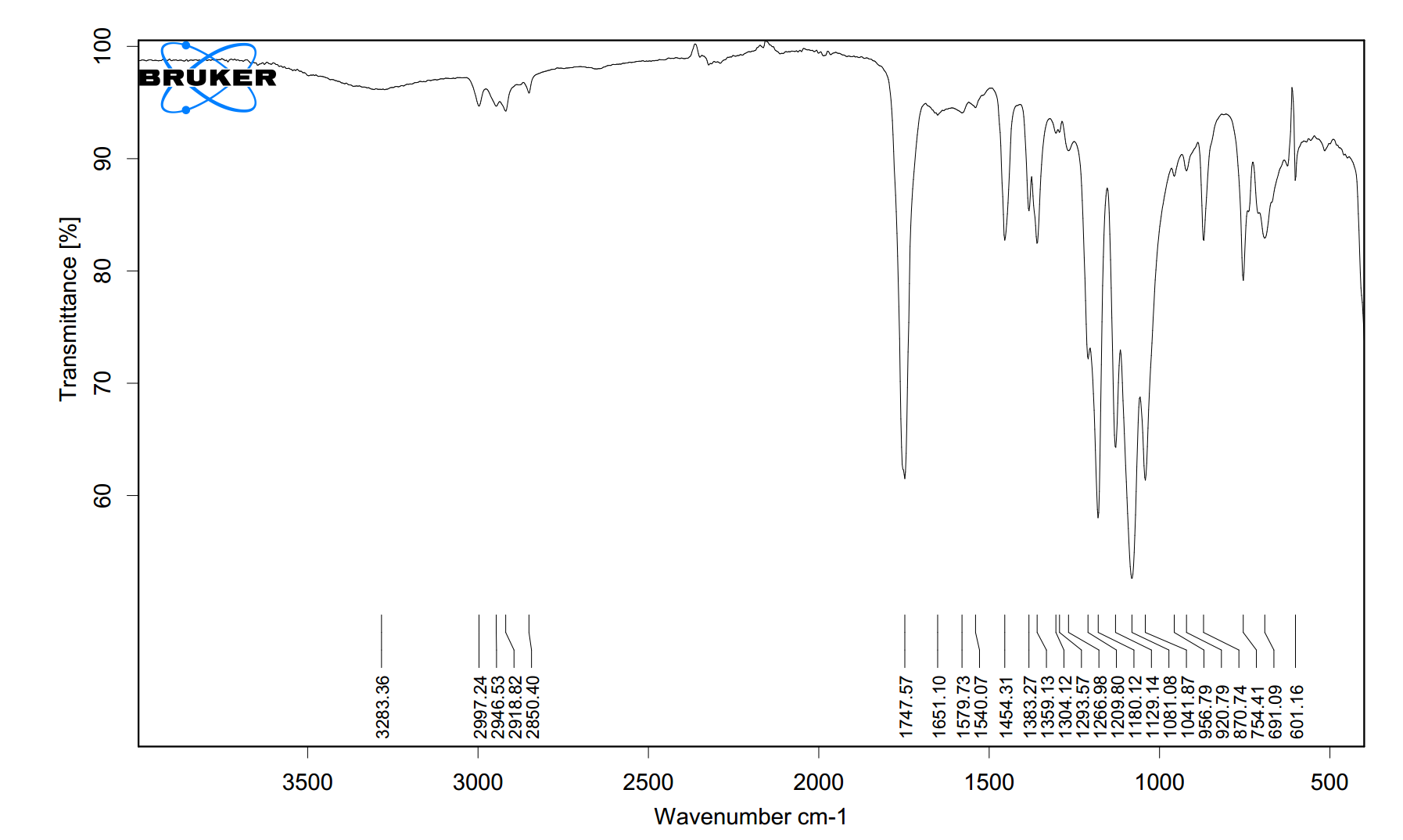
aromatic ether/phenol-like material with carbonyl functionality The FTIR spectrum reveals a pattern consistent with an aromatic ether or phenolic organic material containing a carbonyl component. The combination of aromatic C–H in-plane deformations, ether C–O–C stretching, a band attributable to Ph–OH stretching, and a distinct carbonyl absorption at 1751 cm⁻¹ points toward a partially oxidized aromatic structure, such as a lignin fragment, aromatic ester, or similarly modified phenolic compound. The library search returned only low‑confidence matches; the top hit (trideuterio-(trideuteriomethylsulfinyl)methane) is chemically inconsistent with the observed absorptions, reinforcing a conclusion based on band interpretation rather than a direct library identification.
Supporting peaks
1038 cm-1 1077 cm-1 1125 cm-1 1179 cm-1 1751 cm-1
Supporting groups
methyl aromatic o_c_o silicon_oxygen c_o_single_bond alkyl_c_h aromatic_c_h_in_plane_deformation c_o_stretching
Support

Evidence supporting the conclusion

Only sample-relevant statements that support the present conclusion are shown here.

  1. The FTIR spectrum reveals a pattern consistent with an aromatic ether or phenolic organic material containing a carbonyl component. The combination of aromatic C–H in-plane deformations, ether C–O–C stretching, a band attributable to Ph–OH stretching, and a distinct carbonyl absorption at 1751 cm⁻¹ points toward a partially oxidized aromatic structure, such as a lignin fragment, aromatic ester, or similarly modified phenolic compound. The library search returned only low‑confidence matches; the top hit (trideuterio-(trideuteriomethylsulfinyl)methane) is chemically inconsistent with the observed absorptions, reinforcing a conclusion based on band interpretation rather than a direct library identification.
  2. Direct literature assignments support the presence of alkoxy C–O (1038 cm⁻¹) [3], C–O single bond (1125 cm⁻¹) [2], and carbonyl (1751 cm⁻¹) [5], all consistent with the proposed aromatic ether/phenol direction.
  3. The band at 1038 cm⁻¹ is consistent with C–O–C asymmetric stretching of an ether group, characteristic of an aromatic ether linkage.
  4. The absorptions at 1077 and 1125 cm⁻¹ correspond to aromatic C–H in-plane deformation and C–O deformation in secondary alcohols/ethers, indicating an oxygen‑substituted aromatic ring.
  5. A band at 1179 cm⁻¹ lies within the Ph–OH stretching region (1180–1260 cm⁻¹) and can be attributed to C–O stretching of a phenolic hydroxyl.
  6. The intense band at 1751 cm⁻¹ arises from a carbonyl (C=O) stretching vibration, compatible with ester, carboxylic acid, or ketone functionality often present in oxidized aromatic matrices.
  7. Major peak assignments include 1077: Related literature: aromatic C-H deformation and C-O stretching pattern (aromatic ether/phenol-like) | Direct reference: alkyl c h; c o single bond; 1179: Related literature: aromatic C-H deformation and C-O stretching pattern (aromatic ether/phenol-like) | Direct reference: alkyl c h; c o single bond; 1751: Related literature: unassigned carbonyl region (1751 cm-1) | Direct reference: alkyl c h; c o single bond; 1038: Related literature: aromatic C-H deformation and C-O stretching pattern (aromatic ether/phenol-like) | Direct reference: alkyl c h; c o single bond.
Limitations

Evidence that limits the conclusion

  • The closest spectral library match, trideuterio-(trideuteriomethylsulfinyl)methane, displays aliphatic and sulfoxide character that does not account for the observed aromatic and ether absorptions; this low‑confidence hit is therefore not representative of the sample.
  • The carbonyl band at 1751 cm⁻¹ cannot be assigned unambiguously to ester, acid, or ketone without additional evidence.
  • The exact aromatic substitution pattern and the precise nature of the phenolic component remain unresolved due to limited band specificity and the absence of a high‑confidence library match.
  • The overall direction is based on band interpretation rather than a validated database identification.
Recommendation

Suggested next verification

  • Acetylate the sample and compare FTIR spectra to verify the presence of phenolic hydroxyls (shift of the 1179 cm⁻¹ band).
  • Perform chemical degradation (e.g., thioacidolysis) followed by GC‑MS to identify lignin‑like substructures.
  • Search spectral libraries of lignin derivatives, tannins, or aromatic esters to improve the library match.
  • Consider solid‑state ¹³C NMR to confirm the aromatic and carbonyl functionalities.
Peak analysis

Detected peaks and interpretation

★ = Literature-supported peak assignment.

Index Characteristic Wavenumber Absorbance Evidence One-line interpretation Citation Confidence
1 1077 1.00 Attribution soutenue par la littérature La bande à 1077 cm-1 est attribuée à aromatic C-H deformation and C-O stretching pattern (aromatic ether/phenol like)[S1][S3][S5]. [S1], [S3], [S5] Confiance globale
2 1179 0.28 Attribution soutenue par la littérature La bande à 1179 cm-1 est attribuée à C-O single bond[RC526]. [RC526] Confiance LLM
3 1751 0.24 Attribution soutenue par la littérature La bande à 1751 cm-1 est attribuée à carbonyl[RC887]. [RC887] Confiance globale
4 1038 0.24 Attribution soutenue par la littérature La bande à 1038 cm-1 est attribuée à aromatic C-H deformation and C-O stretching pattern (aromatic ether/phenol like)[S1][S3][S5]. [S1], [S3], [S5] Confiance globale
5 1125 0.19 Attribution soutenue par la littérature La bande à 1125 cm-1 est attribuée à aromatic C-H deformation and C-O stretching pattern (aromatic ether/phenol like)[S1][S3][S5]. [S1], [S3], [S5] Confiance globale
Literature

References

392 local KG peak-level literature source(s) kept in the candidate pool; peaks 1038, 1077, 1125, 1179, 1751; groups acetylation, aldehyde, aliphatic_groups_ch2_and_ch3, alkene.

No. Title Page
[1] Ramadan 和 Ismail - 2022 - Tunning the Physical Properties of PVDFPVCZinc F -
[2] Manupa 等 - 2023 - Storage stability and antioxidant activities of lu -
[3] Khoshnam 等 - 2021 - alpha-Fe2O3graphene oxide powder and thin film na -
[4] Goldsztein 等 - 2010 - Gastric ATPase phosphorylationdephosphorylation m -
[5] Du 等 - 2022 - Intraand Intermolecular Hydrogen Bonding in Misc -
[S1] Zhang 等 - 2022 - Use of ATR-FTIR Spectroscopy and Chemometrics for 6
[S3] Santos 等 - 2023 - Forest by-Product Valorization Pilot-Scale Pinus 10
[S4] Maundrill 等 - 2023 - Moisture and fungal degradation in fibrous plaster 34
[S5] Santiago-Medina 等 - 2017 - Polycondensation Resins by Lignin Reaction with (P 9
[S6] Cai 等 - 2018 - EPS adsorption to goethite Molecular level adsorp 53
[RC526] Lyszczek 等 - 2022 - A Top-Down Approach and Thermal Characterization o 10
[RC887] Lafia-Araga 等 - 2021 - Influence of Lactic Acid Surface Modification of C 6
Appendix

Sample information and raw spectrum

Original uploaded spectrum for reference and verification.

Baseline correction method: Asymmetric Least Squares Smoothing

The wavelength range for analysis(cm-1): N/A

Raw spectrum without baseline correction or other processing:

Sample spectrum image
Discussion

Commentaires et preuves de suivi

Utilisez cette zone pour poursuivre l'interprétation, poser des questions ou ajouter des preuves de vérification supplémentaires.

The above shows the FTIR analysis results of a PDF file uploaded by a user from Malaysia. The original image and extracted CSV file are displayed below.wechat_2026-01-03_050638_198.pngtem.csv
en&2
Soumettre la demande Formulaire