
صفحة النتيجة

amine- or ammonium-containing aliphatic organic material with alkyl C-H and possible N-H/O-H functionality

عرض التقرير أعلاه. استخدم التعليقات أدناه إذا كنت بحاجة إلى مناقشة متابعة.

رقم النتيجة: 20241023160616138658629 المالك: Admin التعليقات: 2
  • Translating report into العربية. English is shown for now.
FTIR ANALYSIS REPORT

Spectrum Analysis Result

No.: 20241023160616138658629 Date: 2024-10-23 15:03:34 Reported by: FTIR.fun Contact: [email protected]

Download a professional, formatted PDF of this analysis.

Top15

Similarity-ranked Top-15 library comparison

The Top-15 workbench is shown directly below so you can inspect the similarity-ranked library matches immediately.

Choose matching result groups:
Library spectrum loads with this Top-15 workbench.
Library spectrum Interactive sample curve Move the pointer to show the vertical guide line.
Top 15 candidates

Reference library candidates

This list helps you compare nearby candidates without repeating the report conclusion.

Rank Match % Compound Name Formula / SMILES Library preview Action
Reference candidates load with this Top-15 workbench.
Executive conclusion

amine- or ammonium-containing aliphatic organic material with alkyl C-H and possible N-H/O-H functionality

ثقة LLM
#13288 Initial rank 1 Current rank 1 Library lead match 0.0%
النتيجة
  1. Library Top-15 candidates are enriched in nitrogen-containing compounds, including amine and ammonium-type entries.
  2. The nearest library label is dimethyl-di(prop-2-enyl)azanium chloride, which is nitrogen-containing and consistent with the broad nitrogen-bearing direction.
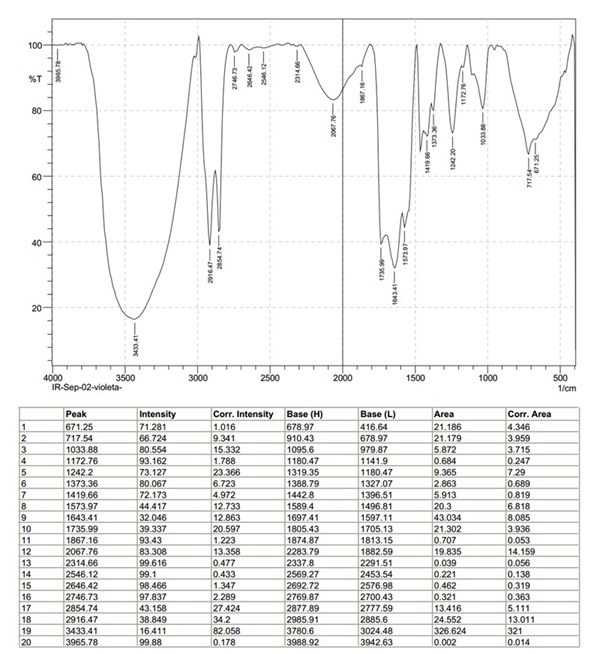
  3. Bands at 2850 and 2914 cm-1 support alkyl C-H groups.
Primary risk

Library similarity values are 0.000 throughout the leading candidates, so the library match is not strong enough for an entity claim.

Detailed explanation Supporting evidence, limitations, and suggested verification steps for this sample.
Evidence

Conclusion evidence

Only evidence relevant to this sample and the present conclusion is shown here.

مطابقة المكتبة الرئيسية
dimethyl-di(prop-2-enyl)azanium chloride #13288 | match 0.0%
اتجاه المادة
amine- or ammonium-containing aliphatic organic material with alkyl C-H and possible N-H/O-H functionality The current FTIR evidence does not support a firm compound-level identification. Although the nearest library entry is dimethyl-di(prop-2-enyl)azanium chloride, the retrieval confidence is effectively zero and there is no direct or related literature confirmation. The observed spectrum is more safely described as an amine- or ammonium-containing aliphatic organic material showing alkyl C-H stretching, a band in the 1642 cm-1 region, and broad high-wavenumber absorption consistent with N-H and/or O-H functionality
Supporting peaks
1642 cm-1 2850 cm-1 2914 cm-1 3246 cm-1 3434 cm-1 3443 cm-1
Supporting groups
nitrogen_heterocycle methyl chlorine bromine ring_5m ring
Support

Evidence supporting the conclusion

Only sample-relevant statements that support the present conclusion are shown here.

  1. The current FTIR evidence does not support a firm compound-level identification. Although the nearest library entry is dimethyl-di(prop-2-enyl)azanium chloride, the retrieval confidence is effectively zero and there is no direct or related literature confirmation. The observed spectrum is more safely described as an amine- or ammonium-containing aliphatic organic material showing alkyl C-H stretching, a band in the 1642 cm-1 region, and broad high-wavenumber absorption consistent with N-H and/or O-H functionality
  2. Library Top-15 candidates are enriched in nitrogen-containing compounds, including amine and ammonium-type entries.
  3. The nearest library label is dimethyl-di(prop-2-enyl)azanium chloride, which is nitrogen-containing and consistent with the broad nitrogen-bearing direction.
  4. Bands at 2850 and 2914 cm-1 support alkyl C-H groups.
  5. Bands at 3246, 3434, and 3443 cm-1 support the presence of N-H and/or O-H functionality.
  6. Observed bands at 2850 and 2914 cm-1 support aliphatic C-H stretching.
  7. Broad absorptions at 3246, 3434, and 3443 cm-1 are consistent with hydrogen-bonded N-H and/or O-H stretching rather than a narrowly defined hydrocarbon-only material.
  8. The 1642 cm-1 band indicates an additional unsaturated or bending-mode contribution, but by itself does not securely establish a specific molecular structure.
  9. The Top-15 library pattern contains several nitrogen-containing candidates, including amines, quaternary ammonium salts, and related nitrogen-bearing materials, so nitrogen functionality is a reasonable broad direction.
  10. However, the leading library matches all have zero similarity and no reference source independently narrows the assignment.
Limitations

Evidence that limits the conclusion

These points explain what still weakens, limits, or leaves uncertainty in the current interpretation.

  • Library similarity values are 0.000 throughout the leading candidates, so the library match is not strong enough for an entity claim.
  • No direct reference evidence was available to support the specific library compound.
  • No related literature evidence was recovered to support a narrower assignment.
  • The sample evidence does not clearly confirm specific distinguishing features required for the named top hit, such as secure allylic or quaternary-ammonium-specific band patterns.
  • The high-wavenumber broad bands could arise from amine, ammonium-associated moisture, alcohol, or other hydrogen-bonded functionality.
  • The 1642 cm-1 feature is not unique and may reflect H-O-H bending, N-H bending, C=C-related absorption, or another overlapping mode.
  • Because no reliable literature or high-quality library agreement is present, the exact identity and whether the material is a discrete small molecule, salt, or polymeric nitrogen-containing material remain uncertain.
  • Library similarity values are 0.000 throughout the leading candidates, so the library match is not strong enough for an entity claim
  • No direct reference evidence was available to support the specific library compound
  • No related literature evidence was recovered to support a narrower assignment
  • The sample evidence does not clearly confirm specific distinguishing features required for the named top hit, such as secure allylic or quaternary-ammonium-specific band patterns
  • The leading library assignment to dimethyl-di(prop-2-enyl)azanium chloride is not strongly supported because the reported similarity is 0.000
  • No direct reference evidence or related literature evidence narrows the sample to the named library compound
  • The high-wavenumber broad bands could arise from amine, ammonium-associated moisture, alcohol, or other hydrogen-bonded functionality
  • The 1642 cm-1 feature is not unique and may reflect H-O-H bending, N-H bending, C=C-related absorption, or another overlapping mode
  • Because no reliable literature or high-quality library agreement is present, the exact identity and whether the material is a discrete small molecule, salt, or polymeric nitrogen-containing material remain uncertain
  • It remains uncertain whether the 1642 cm⁻¹ band arises from C=C stretching, adsorbed water bending, or another polar functionality
  • It is not yet clear whether the sample is a small ammonium salt, an amine-containing polymer/additive, or a hydrated/impure nitrogen-containing organic material
  • Halide identity and the exact nitrogen environment cannot be established from the present FTIR evidence alone
  • It remains uncertain whether the high-wavenumber broad band is dominated by O-H, N-H, or adsorbed water
  • The 1642 cm-1 band is nonspecific and does not securely distinguish between water-related, amine-related, or unsaturation-related origins
  • It remains unclear whether the 1642 cm⁻¹ feature arises from alkene C=C, water bending, or another functional group
  • The high-wavenumber broad bands could indicate O–H, primary/secondary amine N–H, adsorbed water, or a mixture, and this ambiguity prevents a narrower assignment
  • Because only a few peaks are available and no direct reference interpretation is provided, the sample may be a mixture, hydrated salt, or contaminated surface residue rather than a single pure compound
Recommendation

Suggested next verification

These are the most useful next checks for confirming the present conclusion or refining a low-match result.

  • Repeat the FTIR measurement after careful drying to determine whether the 3434-3443 and 1642 cm-1 bands are partly due to absorbed water.
  • Inspect the fingerprint region with higher signal quality, especially approximately 1500-700 cm-1, for characteristic C-N, allylic, or ammonium-associated bands that could better separate amine, ammonium salt, and hydroxyl-containing possibilities.
  • If the dimethyl-di(prop-2-enyl)azanium chloride assignment is important, confirm with a complementary method such as NMR or mass spectrometry, since the present FTIR evidence is not sufficiently specific.
  • If an ionic ammonium material is suspected, compare against authenticated spectra of quaternary ammonium salts and related amine-containing standards measured under the same conditions.
Peak analysis

Detected peaks and interpretation

Rows marked with ★ are characteristic peaks selected by the analyzer.

Index Characteristic Wavenumber Absorbance Evidence One-line interpretation Citation Confidence
1 · 3434 1.00 - 3434 cm-1: possible source: Refer to AI conclusion. - -
2 · 3443 0.89 - 3443 cm-1: possible source: Refer to AI conclusion. - -
3 · 3246 0.28 - 3246 cm-1: possible source: Refer to AI conclusion. - -
4 · 1642 0.24 - 1642 cm-1: possible source: Refer to AI conclusion. - -
5 · 2914 0.19 - 2914 cm-1: possible source: Refer to AI conclusion. - -
6 · 2850 0.16 - 2850 cm-1: possible source: Refer to AI conclusion. - -
Appendix

Sample information and raw spectrum

The raw uploaded spectrum is retained here for audit and manual review.

Baseline correction method: Asymmetric Least Squares Smoothing

The wavelength range for analysis(cm-1): [(650, 4000)]

Raw spectrum without baseline correction or other processing:

No raw spectrum image

مناقشة

التعليقات والأدلة المتابعة

استخدم هذه المساحة لمتابعة التفسير أو طرح الأسئلة أو إضافة أدلة تحقق إضافية.

Based on the possible hydroxyl absorption peak around 3500 and the possible hydrocarbon absorption peak around 1500, the sample resembles a surfactant and may be a salt containing long-chain alkanes.

en&2

This is the search result for the file with the extension .pdf uploaded by user 103.xxx.xxx.180, raw image:1.jpg
en&2
إرسال الطلب نموذج