**Data:** The provided FTIR spectrum exhibits numerous absorption peaks across the fingerprint region (660-1900 cm⁻¹), the C-H stretching region (~2872-2968 cm⁻¹), and the high-frequency region (~3726-3992 cm⁻¹). The most prominent feature is a very strong, sharp peak at 1767 cm⁻¹. Other notable peaks include a medium broad peak at 903 cm⁻¹, a medium broad peak at 951 cm⁻¹, and a cluster of weak, sharp peaks between 1712-1900 cm⁻¹. Several weak, sharp peaks are present in the 3726-3817 cm⁻¹ range.
**Analysis:** * **Peak at 1767 cm⁻¹ (Strong, Sharp):** This is the dominant feature. Its position and sharpness are characteristic of a carbonyl (C=O) stretching vibration. The high intensity suggests a high concentration or a strongly absorbing carbonyl group. The specific position is typical for a five-membered cyclic anhydride (succinic anhydride-type, ~1840 & ~1780 cm⁻¹ for asymmetric/symmetric stretches) or a saturated aliphatic ester (~1740-1750 cm⁻¹). The exact value of 1767 cm⁻¹ is slightly high for a simple ester but aligns well with the higher-frequency component (symmetric stretch) of a cyclic anhydride. * **Peaks between 1712-1900 cm⁻¹ (Weak, Sharp/Broad):** This cluster includes peaks at 1712, 1820, 1836 (broad), 1867, and 1900 cm⁻¹. The peak at 1712 cm⁻¹ could be attributed to a second, possibly conjugated or carboxylic acid carbonyl. The series of peaks above 1800 cm⁻¹ is highly indicative of the characteristic pattern for **cyclic anhydrides**, which typically show two C=O stretches: an asymmetric stretch at higher wavenumber (~1820-1850 cm⁻¹) and a symmetric stretch at lower wavenumber (~1750-1780 cm⁻¹). The presence of multiple weak peaks in this region may suggest a mixture, Fermi resonance, or the presence of different anhydride environments. * **Peaks in 3726-3817 cm⁻¹ region (Weak, Sharp):** These are characteristic of free, non-hydrogen-bonded O-H stretching vibrations. In the context of other peaks, these likely indicate isolated silanol (Si-OH) groups or possibly very dilute, free alcohol/phenol O-H, though the former is more common in this precise wavenumber range for surface species. * **Peaks at 2872, 2891, 2951 (broad), 2968 (broad) cm⁻¹:** These correspond to C-H stretching vibrations: ~2872-2891 cm⁻¹ (symmetric CH₃/CH₂), ~2951-2968 cm⁻¹ (asymmetric CH₃). * **Peaks at 1627, 1637, 1649 (broad) cm⁻¹:** These could be attributed to C=C stretching (alkene, possibly conjugated) and/or adsorbed water (H-O-H bending ~1640 cm⁻¹). The weak, sharp nature leans more towards C=C. * **Peak at 1562 cm⁻¹ (Weak, Sharp):** Possibly C=C stretching in an aromatic ring or C=O of a carboxylate anion (asymmetric stretch). * **Peaks at 1387, 1395, 1407 cm⁻¹:** Often associated with O-H in-plane bending (of carboxylic acids) or CH deformation vibrations. * **Peaks in 1000-1300 cm⁻¹ region:** A complex fingerprint region with multiple weak peaks (e.g., 1044, 1076, 1126, 1214, 1228, 1279 cm⁻¹). These are consistent with C-O stretching vibrations (esters, anhydrides, alcohols) and C-C skeletal vibrations. * **Peaks below 1000 cm⁻¹ (660-968 cm⁻¹):** Several weak, broad peaks. These are in the region for C-H out-of-plane bending (for alkenes/aromatics) and possibly Si-O or M-O (metal-oxygen) vibrations if inorganic components are present.
**Conclusions/Inferences:** 1. **Primary Component:** The spectrum is **dominated by a cyclic aliphatic anhydride** functional group. This is conclusively indicated by the very strong carbonyl stretch at 1767 cm⁻¹ coupled with the characteristic weaker peaks in the 1820-1867 cm⁻¹ region, which form the classic doublet for cyclic anhydrides. 2. **Other Functional Groups Present:** * **Aliphatic Hydrocarbons:** Confirmed by C-H stretches (~2872-2968 cm⁻¹). * **Isolated Silanol (Si-OH) Groups or Free O-H:** Indicated by sharp peaks in the 3726-3817 cm⁻¹ range. **[Inference:** The precise wavenumbers are highly typical for surface silanols on silica or silicate materials.**]** * **C=C Bonds:** Likely present (peaks ~1627-1649 cm⁻¹), possibly in an alkene or as part of an unsaturated anhydride derivative. * **C-O Bonds:** Multiple absorptions in the 1000-1300 cm⁻¹ region confirm C-O-C linkages from the anhydride and possibly other esters/ethers. 3. **[Inference on Sample Nature:** Based on the co-existence of a strong cyclic anhydride pattern and
This discussion presents an infrared spectral analysis combining
automated interpretation with reference comparison to support
functional group identification and structural assessment.

FTIR Spectrum Interpretation Summary
Comparative Analysis Conclusion
AI-assisted Interpretation Conclusion
**Data → Analysis → Conclusions/Inferences**
**Data:**
The provided FTIR spectrum exhibits numerous absorption peaks across the fingerprint region (660-1900 cm⁻¹), the C-H stretching region (~2872-2968 cm⁻¹), and the high-frequency region (~3726-3992 cm⁻¹). The most prominent feature is a very strong, sharp peak at 1767 cm⁻¹. Other notable peaks include a medium broad peak at 903 cm⁻¹, a medium broad peak at 951 cm⁻¹, and a cluster of weak, sharp peaks between 1712-1900 cm⁻¹. Several weak, sharp peaks are present in the 3726-3817 cm⁻¹ range.
**Analysis:**
* **Peak at 1767 cm⁻¹ (Strong, Sharp):** This is the dominant feature. Its position and sharpness are characteristic of a carbonyl (C=O) stretching vibration. The high intensity suggests a high concentration or a strongly absorbing carbonyl group. The specific position is typical for a five-membered cyclic anhydride (succinic anhydride-type, ~1840 & ~1780 cm⁻¹ for asymmetric/symmetric stretches) or a saturated aliphatic ester (~1740-1750 cm⁻¹). The exact value of 1767 cm⁻¹ is slightly high for a simple ester but aligns well with the higher-frequency component (symmetric stretch) of a cyclic anhydride.
* **Peaks between 1712-1900 cm⁻¹ (Weak, Sharp/Broad):** This cluster includes peaks at 1712, 1820, 1836 (broad), 1867, and 1900 cm⁻¹. The peak at 1712 cm⁻¹ could be attributed to a second, possibly conjugated or carboxylic acid carbonyl. The series of peaks above 1800 cm⁻¹ is highly indicative of the characteristic pattern for **cyclic anhydrides**, which typically show two C=O stretches: an asymmetric stretch at higher wavenumber (~1820-1850 cm⁻¹) and a symmetric stretch at lower wavenumber (~1750-1780 cm⁻¹). The presence of multiple weak peaks in this region may suggest a mixture, Fermi resonance, or the presence of different anhydride environments.
* **Peaks in 3726-3817 cm⁻¹ region (Weak, Sharp):** These are characteristic of free, non-hydrogen-bonded O-H stretching vibrations. In the context of other peaks, these likely indicate isolated silanol (Si-OH) groups or possibly very dilute, free alcohol/phenol O-H, though the former is more common in this precise wavenumber range for surface species.
* **Peaks at 2872, 2891, 2951 (broad), 2968 (broad) cm⁻¹:** These correspond to C-H stretching vibrations: ~2872-2891 cm⁻¹ (symmetric CH₃/CH₂), ~2951-2968 cm⁻¹ (asymmetric CH₃).
* **Peaks at 1627, 1637, 1649 (broad) cm⁻¹:** These could be attributed to C=C stretching (alkene, possibly conjugated) and/or adsorbed water (H-O-H bending ~1640 cm⁻¹). The weak, sharp nature leans more towards C=C.
* **Peak at 1562 cm⁻¹ (Weak, Sharp):** Possibly C=C stretching in an aromatic ring or C=O of a carboxylate anion (asymmetric stretch).
* **Peaks at 1387, 1395, 1407 cm⁻¹:** Often associated with O-H in-plane bending (of carboxylic acids) or CH deformation vibrations.
* **Peaks in 1000-1300 cm⁻¹ region:** A complex fingerprint region with multiple weak peaks (e.g., 1044, 1076, 1126, 1214, 1228, 1279 cm⁻¹). These are consistent with C-O stretching vibrations (esters, anhydrides, alcohols) and C-C skeletal vibrations.
* **Peaks below 1000 cm⁻¹ (660-968 cm⁻¹):** Several weak, broad peaks. These are in the region for C-H out-of-plane bending (for alkenes/aromatics) and possibly Si-O or M-O (metal-oxygen) vibrations if inorganic components are present.
**Conclusions/Inferences:**
1. **Primary Component:** The spectrum is **dominated by a cyclic aliphatic anhydride** functional group. This is conclusively indicated by the very strong carbonyl stretch at 1767 cm⁻¹ coupled with the characteristic weaker peaks in the 1820-1867 cm⁻¹ region, which form the classic doublet for cyclic anhydrides.
2. **Other Functional Groups Present:**
* **Aliphatic Hydrocarbons:** Confirmed by C-H stretches (~2872-2968 cm⁻¹).
* **Isolated Silanol (Si-OH) Groups or Free O-H:** Indicated by sharp peaks in the 3726-3817 cm⁻¹ range. **[Inference:** The precise wavenumbers are highly typical for surface silanols on silica or silicate materials.**]**
* **C=C Bonds:** Likely present (peaks ~1627-1649 cm⁻¹), possibly in an alkene or as part of an unsaturated anhydride derivative.
* **C-O Bonds:** Multiple absorptions in the 1000-1300 cm⁻¹ region confirm C-O-C linkages from the anhydride and possibly other esters/ethers.
3. **[Inference on Sample Nature:** Based on the co-existence of a strong cyclic anhydride pattern and
This discussion presents an infrared spectral analysis combining automated interpretation with reference comparison to support functional group identification and structural assessment.
RAW IMAGE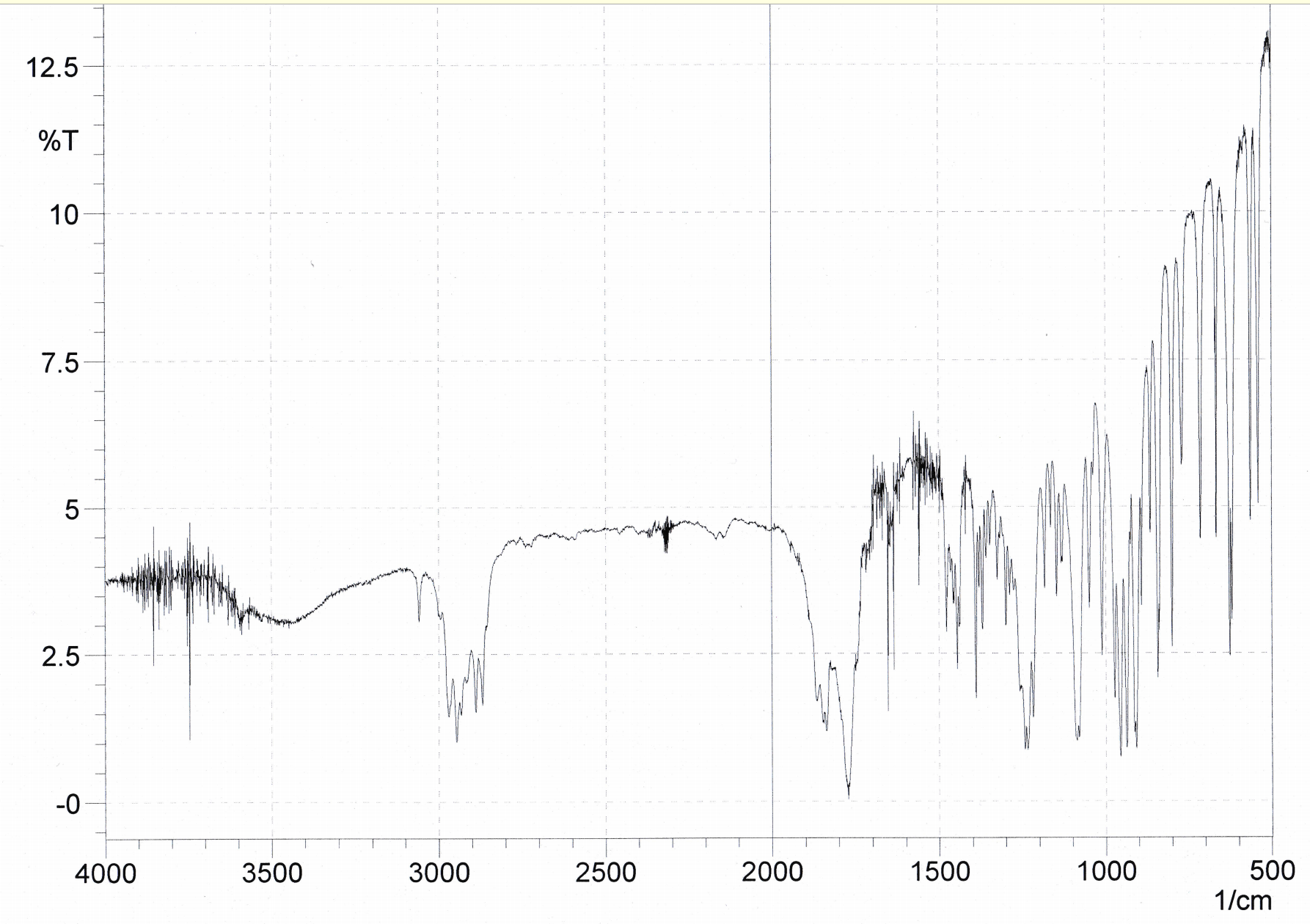 tem.csv
en&2